
Why Credit Card Age Verification Fails (And How Underage Buyers Bypass It)
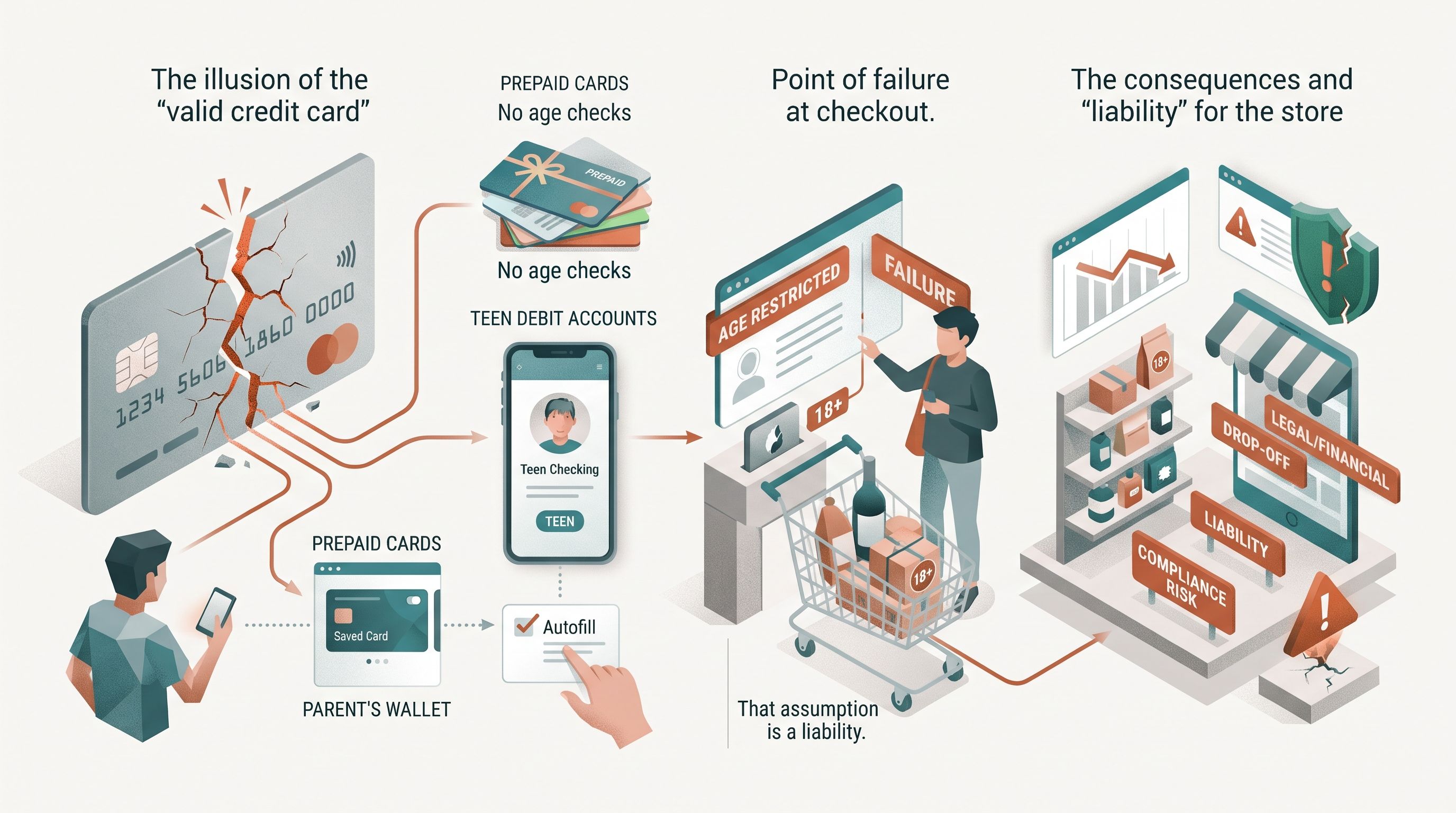
A valid credit card used to feel like proof of adulthood. Prepaid cards, teen debit accounts and a parent's saved wallet have made that assumption a liability for any store selling age-restricted products.

For years, online merchants selling age-restricted goods operated under a simple assumption: if a customer has a credit card, they must be at least 18.
After all, major banks and credit card issuers require applicants to be legal adults before opening a credit line. To many store owners, collecting a valid 16-digit card number and billing address at checkout felt like a built-in, zero-friction age check.
Today, that assumption is both outdated and risky.
Whether you are enforcing state age mandates, adhering to merchant processor rules, or maintaining store policies for age-restricted merchandise, relying on a credit card to verify age no longer holds up. Here is why credit card age verification fails, how easily it gets bypassed, and what merchants can do instead.
How Underage Buyers Bypass Credit Card Age Checks
Payment networks are built to move money, not verify date of birth. Because card processors do not pass the cardholder’s age back to the merchant during authorization, an eCommerce checkout cannot tell the difference between a 35-year-old adult and a 16-year-old using one of four common workarounds:
- Prepaid Gift Cards (Visa, Mastercard, Amex): Anyone of any age can walk into a grocery store or pharmacy with cash, buy a prepaid Visa or Mastercard gift card, and enter it into an online checkout just like a standard credit card.
- Teen Debit Cards & Youth Banking Apps: Modern fintech platforms (like Greenlight, Step, and Cash App) along with major banks issue Visa and Mastercard debit cards explicitly designed for minors aged 13 to 17. To your payment gateway, they look identical to adult bank cards.
- Authorized Users on Family Accounts: Most major credit card issuers allow primary cardholders to add minor children as authorized users—issuing a physical card with the teenager's own name printed on the front.
- Borrowed or Saved Parent Cards: Without biometric or identity matching at checkout, a minor using a parent's card saved in Chrome Autofill or Apple Pay sails right through payment processing without triggering a single flag.
Why Credit Cards Don't Satisfy Compliance or Risk Standards
Because payment cards are so easily obtained by minors, regulators, card networks, and high-risk merchant processors do not accept payment authorization as proof of age.
- Zero Date-of-Birth Data: When you run a credit card transaction, the card network verifies available funds, AVS (Address Verification Service), and CVV. It never confirms whether the buyer is 18, 21, or 65.
- No Audit Trail of Due Diligence: Modern age-gating standards require verifiable proof that the merchant checked the buyer's identity prior to shipment. Simply pointing to a settled credit card transaction provides zero evidence of age verification if a regulator, insurer, or payment processor reviews your fulfillment logs.
- Chargeback & Friendly Fraud Exposure: When a minor uses a parent’s card to buy restricted goods online, the merchant inevitably eats the dispute. Once the parent sees the charge, they file a chargeback—leaving the merchant without the product, without the revenue, and stuck with costly dispute fees.
Moving Beyond Payment Cards: Zero-Retention Verification
If a credit card cannot prove who is behind the screen, how do you verify age without ruining your checkout conversion rate or storing sensitive customer documents on your server?
This is where Entrinsia ZeroTrust replaces outdated assumptions with real verification:
- 30-Second In-Checkout Flow: Rather than relying on the payment method as a proxy for age, buyers complete a quick, guided verification directly inside checkout before payment finalizes.
- Document & Liveness Verification: Our system validates government-issued ID data, checks age thresholds, and matches the ID photo to a live biometric selfie—confirming the buyer is genuinely an adult, not a minor using a prepaid card or a parent's wallet.
- Zero PII Stored on Your Servers: Once the age check clears, the raw driver's license image and biometric selfie are immediately destroyed. You never store sensitive customer documents or take on CCPA data breach liability.
- An Immutable Verification Receipt: Instead of hoping a credit card transaction counts as proof of age, your store retains a tamper-evident audit record showing that the ID was examined, any required attestation was executed, and the photo matched the live buyer.
Stop Relying on Payment Methods for Age Verification
Accepting a credit card proves a buyer has a way to pay—nothing more. Treating payment processing as an identity check leaves your business exposed to underage sales, chargebacks, and processor disputes.
By separating payment processing from true, zero-retention identity verification, you keep your checkout fast while ensuring every restricted order goes to a verified adult.
Ready to Get Started?
See how ZeroTrust can verify identities in under 30 seconds.
Related Articles

California AB 1263: What Firearms Retailers Need to Know About the New Accessory Law
Assembly Bill 1263 takes effect January 1, 2026, creating new age verification and compliance requirements for selling firearm accessories to California residents. Complete guide for retailers.

Friction After the Click: Why the "Email Your ID" Workflow Is Silently Killing Your California Sales
Emailing customers for ID photos after checkout feels free, but it stalls orders, locks up inventory and invites chargebacks. Part 1 of a series on the hidden cost of manual AB 1263 compliance.

The "$0" Illusion: The Hidden Labor and Data Liability of Manual ID Verification
Manual ID checks cost far more than they appear to: hours of support payroll every month, plus driver licenses piling up in email inboxes. Part 2 of a series on the hidden cost of manual AB 1263 compliance.